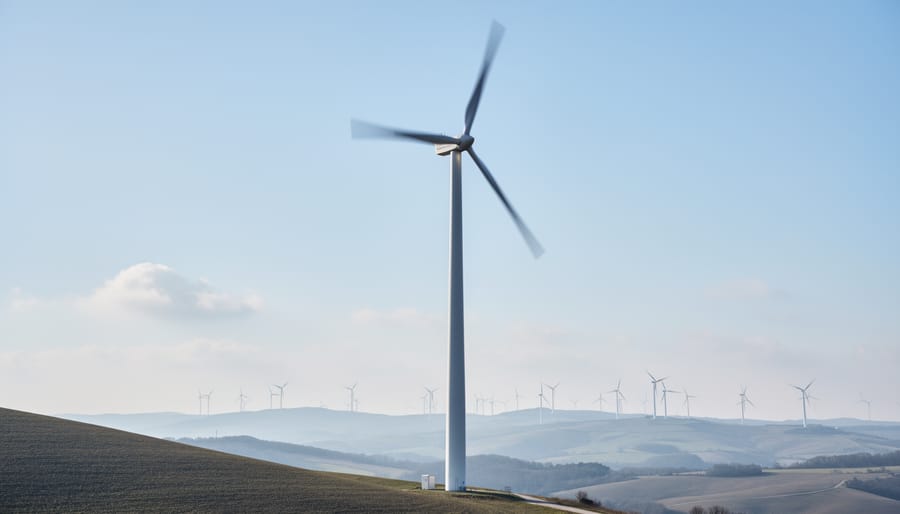
The carbon footprint of wind energy refers to the total greenhouse gas emissions generated across the entire lifecycle of a wind turbine, from mining raw materials and manufacturing components to transportation, installation, operation, and eventual decommissioning. While wind turbines produce zero emissions during operation, they do carry an upfront carbon cost that typically gets paid back within six to twelve months of clean energy generation.
If you’ve wondered whether wind power lives up to its green reputation, you’re asking the right question. The answer matters because understanding the full environmental picture helps you make informed decisions about which renewable energy sources truly deliver on climate promises. Wind energy isn’t carbon-free, but it comes remarkably close when you look at the numbers over time.
Here’s what the data shows: wind turbines emit roughly 11 grams of CO2 per kilowatt-hour over their 20 to 25 year lifespan. Compare that to coal at 820 grams or natural gas at 490 grams per kilowatt-hour, and the difference becomes crystal clear. Even accounting for the steel in the tower, the fiberglass in the blades, and the concrete in the foundation, wind energy’s renewable carbon footprint remains a fraction of fossil fuel alternatives.
This article breaks down exactly where those emissions come from, how the payback period works, and what manufacturers are doing to shrink the footprint even further. You’ll get concrete numbers, real-world comparisons, and practical context for evaluating wind energy as part of your sustainability journey.
What Carbon Footprint Really Means for Wind Energy
When we talk about the carbon footprint of wind energy, we’re measuring all greenhouse gas emissions produced throughout a wind turbine’s entire existence. This isn’t just about the electricity generation itself, wind turbines produce zero emissions while spinning, but rather the full story from the moment raw materials are dug from the earth to the day the turbine is dismantled decades later.
This comprehensive approach is called lifecycle assessment. It tracks emissions at every stage: extracting iron ore and mining rare earth elements, manufacturing turbine components in factories, shipping massive blades and towers to remote sites, constructing foundations and erecting turbines, maintaining equipment over 20-25 years, and eventually recycling or disposing of materials. Each phase has a carbon cost, even if the turbine itself generates clean power once operational.
To make meaningful comparisons, we measure wind energy’s impact in g CO2e per kWh grams of carbon dioxide equivalent emitted for every kilowatt-hour of electricity produced. This standard metric lets us compare wind fairly against coal, natural gas, solar panels, or any other power source on an apples-to-apples basis.
Understanding these key terms helps clarify what we’re actually measuring:
- Lifecycle Assessment
- A method that accounts for all environmental impacts from raw material extraction through manufacturing, use, and disposal. It captures the complete picture rather than looking at just one phase in isolation.
- Embodied Carbon
- The total greenhouse gas emissions from producing and installing a wind turbine before it generates its first watt of electricity. This upfront carbon debt gets paid back through years of clean power generation.
- Operational Emissions
- Greenhouse gases released during the turbine’s working life, mainly from occasional maintenance activities. For wind energy, these emissions are nearly zero since no fuel is burned to generate electricity.
- Carbon Payback Period
- The time it takes for a wind turbine to generate enough clean electricity to offset all emissions from its manufacturing and installation. For modern turbines, this typically happens within 6-12 months of operation.
This lifecycle perspective reveals why wind energy ranks among the cleanest electricity sources available, even when we account for every bolt, concrete pour, and transport truck involved in bringing turbines to life.
How Wind Energy’s Carbon Footprint Works
Manufacturing and Materials
The steel tower alone accounts for roughly 70-80% of a wind turbine’s total weight, requiring energy-intensive blast furnaces that traditionally run on fossil fuels. A single 3-megawatt turbine needs approximately 200-350 tonnes of steel, enough to manufacture about 50 cars. The concrete foundation anchoring it in place adds another 400-1,000 tonnes, depending on turbine size and soil conditions.
Fiberglass blades present their own carbon challenge. Manufacturing these massive structures requires resins derived from petrochemicals, plus significant energy to shape and cure them. Each blade can weigh 10-20 tonnes and stretch longer than a Boeing 747 wing.
The generator housing contains copper wiring and permanent magnets made from rare earth elements like neodymium and dysprosium. Mining and refining these materials is particularly carbon-intensive, though they represent a small fraction of the turbine’s total weight.
Manufacturing efficiency has improved dramatically since 2010. Turbine makers now source steel from mills using electric arc furnaces powered by renewables, optimize blade designs to use less material, and develop recycled rare earth recovery processes. These advances have cut manufacturing emissions per kilowatt-hour by 30-40% over the past decade.
Installation and Infrastructure
Site preparation and infrastructure development contribute notable but temporary emissions to wind energy’s carbon footprint. Building access roads robust enough to transport 100-ton turbine components requires diesel-powered excavators, graders, and compactors. A typical wind farm needs several miles of reinforced roadways capable of supporting massive cranes, each kilometer of road can emit 50-100 tons of CO2 from construction alone.
Foundation work adds significant emissions too. Each turbine requires a concrete base weighing 300-500 tons, with cement production being particularly carbon-intensive. Offshore installations multiply these impacts: specialized vessels, underwater cabling, and complex foundation systems like monopiles or floating platforms require substantial energy. Grid connection infrastructure, substations, transformers, and transmission lines linking the farm to existing networks, adds another layer of emissions.
However, these upfront costs occur once, then the turbine generates clean electricity for two decades or more. Site restoration after construction can even sequester some carbon through revegetation around turbine bases.
Operation and Maintenance
Once a wind turbine begins spinning, its carbon footprint drops to nearly zero. Unlike fossil fuel plants that burn fuel with each kilowatt-hour produced, wind turbines generate electricity with no direct emissions. Over their typical 20 to 25 year operational life, the only carbon costs come from occasional maintenance visits, technicians driving to remote sites, replacing worn bearings or gearbox components, and periodic inspections using vehicles or cranes. These maintenance-related emissions amount to roughly 1-2 grams of CO2 per kilowatt-hour, a fraction of the manufacturing footprint. With proper maintenance turbines can operate for decades while their initial carbon debt gets paid back many times over through clean electricity generation.
Decommissioning and End-of-Life
When a wind turbine reaches the end of its 20-25 year lifespan, decommissioning adds minimal carbon to the overall footprint, typically less than 2% of total lifecycle emissions. The tower, nacelle, and internal components are 80-90% recyclable: steel gets melted down for new construction, copper wiring returns to industrial use, and most mechanical parts find second lives. The concrete foundation can often be left in place or crushed for aggregate.
The real challenge lies with turbine blades. Made from fiberglass or carbon fiber composite, they resist traditional recycling methods. Currently, most retired blades end up in landfills, though new techniques are emerging, cement kilns can burn them for fuel, mechanical shredding produces material for construction panels, and chemical processes show promise for recovering pure fibers. Several manufacturers now design blades specifically for easier recycling, embracing circular economy principles that treat end-of-life as a design consideration rather than an afterthought.
Different Types of Wind Energy Installations
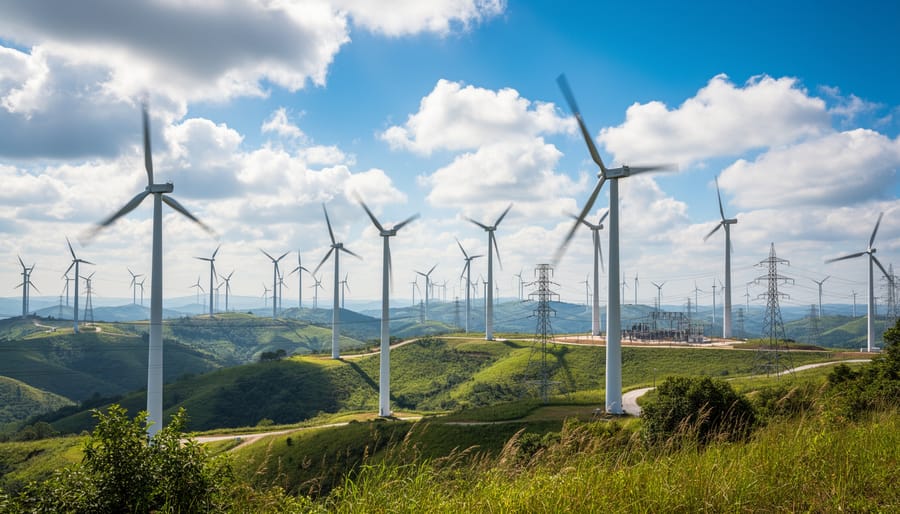
Wind energy installations come in three main forms, each with distinct carbon footprint characteristics shaped by their construction requirements, location, and power generation potential.
Onshore wind farms represent the most established and lowest-carbon option. These land-based installations typically generate 7-12 g CO2e/kWh over their lifetime. Their manufacturing emissions are spread across accessible sites where construction equipment can reach relatively easily, and foundations can be built with less intensive engineering. Transport distances matter here, turbines installed closer to manufacturing facilities carry fewer emissions than those shipped across continents. The concrete and steel foundations for onshore turbines are substantial, but they’re straightforward compared to offshore alternatives.
Offshore wind farms carry higher upfront carbon costs, usually resulting in 15-20 g CO2e/kWh. The difference comes from specialized installation vessels, larger and more robust foundations designed to withstand marine conditions, longer undersea cables to connect to shore, and the corrosion-resistant materials needed for saltwater environments. A single offshore turbine might require a massive steel jacket foundation driven deep into the seabed, or floating platforms anchored with heavy chains. However, offshore turbines access stronger, more consistent winds, often generating 40-50% more electricity than comparable onshore turbines. This higher capacity factor means they produce more clean energy over their lifespan to offset those manufacturing emissions.
Distributed small-scale turbines for homes or small businesses present a mixed picture. Individual residential turbines may have a higher per-kilowatt carbon footprint because manufacturing efficiency favors large-scale production, and they typically generate less electricity than their utility-scale counterparts due to lower wind speeds at ground level. Yet they eliminate transmission infrastructure emissions.
Location-specific factors significantly affect carbon intensity across all types. A wind farm built where manufacturing relies on coal power will have higher embedded emissions than one produced using renewable energy. Sites with excellent wind resources pay back their carbon debt faster, a turbine running at 45% capacity factor becomes carbon-neutral months sooner than one at 25%. Local geology matters too: rock foundations require less concrete than those built on soft soil, reducing overall emissions.
Real-World Applications and Benefits
Understanding wind energy’s carbon footprint moves beyond theory when organizations and individuals make real energy decisions. Knowing that a turbine generates carbon-free electricity for 20-plus years after offsetting its manufacturing emissions in under a year fundamentally shapes how we plan our energy future.
Utility companies use lifecycle carbon data to design grid decarbonization strategies that meet climate targets while maintaining reliability. When choosing between renewable options, they compare wind’s 7-20 g CO2e/kWh against solar’s 30-80 g or natural gas’s 400+ g to determine which investments deliver the fastest emissions reductions. A regional utility might prioritize offshore wind development knowing the higher upfront footprint still results in massive carbon savings compared to retiring coal plants.
Corporations making sustainability commitments rely on this data to meet their net-zero targets. A tech company pledging carbon neutrality by 2030 can confidently sign power purchase agreements for wind farms, knowing the lifecycle emissions are accurately quantified and independently verified. These contracts often specify that renewable energy credits represent actual carbon displacement, not just theoretical calculations.
This carbon footprint knowledge helps guide practical decisions across multiple scales:
– Grid operators planning long-term generation portfolios to hit decarbonization milestones
– Businesses evaluating renewable energy procurement to meet sustainability reporting standards
– Homeowners comparing rooftop solar, community wind programs, and utility green energy options
– Policymakers setting renewable energy standards and carbon reduction benchmarks
– Investment firms assessing which clean energy technologies deliver the greatest climate impact per dollar
Community energy projects use comparative carbon data when advocating for local wind development. When a rural cooperative proposes a wind farm, presenting hard numbers about lifecycle emissions helps counter concerns about environmental impact. Demonstrating that the project will offset its carbon footprint within months and deliver clean power for decades makes the case compelling.
Financial institutions incorporate lifecycle carbon assessments into clean energy lending decisions. Banks evaluating wind farm financing analyze the carbon payback period alongside financial returns, recognizing that faster carbon neutrality reduces regulatory and market risks. This integration of carbon metrics into capital allocation accelerates the renewable energy transition at the scale needed for meaningful climate action.
How Wind Energy Compares to Other Energy Sources
When you compare wind energy’s carbon footprint to other electricity sources, the differences become strikingly clear. Wind turbines typically emit just 7-20 grams of CO2 equivalent per kilowatt-hour over their lifetime, placing them among the cleanest energy options available in 2026.
Fossil fuels sit at the opposite end of the spectrum. Coal power plants generate roughly 820-1,000 g CO2e/kWh when you account for extraction, processing, transportation, and combustion. Natural gas performs better at around 400-500 g CO2e/kWh, but still produces 20-70 times more carbon than wind energy. Even when coal plants add carbon capture technology, they rarely drop below 200 g CO2e/kWh, still ten times higher than wind.
Among renewable sources, wind holds a significant advantage. Solar photovoltaic systems produce about 30-80 g CO2e/kWh depending on panel type and manufacturing location. The wind vs solar comparison reveals that while both are excellent low-carbon choices, wind edges ahead in lifecycle emissions. Hydroelectric power ranges from 10-80 g CO2e/kWh, with large reservoirs in tropical climates producing methane that pushes them toward the higher end. Nuclear energy delivers about 10-30 g CO2e/kWh, comparable to wind, though uranium mining and enrichment account for most of those emissions.
These numbers aren’t abstract, they translate directly into climate impact. A coal plant producing one terawatt-hour of electricity emits roughly 820,000 tonnes of CO2, while a wind farm generating the same amount releases only 7,000-20,000 tonnes. That difference matters when you’re choosing electricity providers or evaluating renewable energy installations.
Research on utility-scale wind emissions shows these figures have improved steadily as turbines grow larger and more efficient. Modern turbines spread their manufacturing footprint across more electricity generation, driving down the per-kilowatt-hour emissions even further.
For anyone making energy decisions in 2026, whether selecting a utility provider’s renewable program or planning a community project, wind stands out as one of the most climate-friendly options available. Its carbon footprint rivals only hydroelectric and nuclear power while avoiding their site limitations and public acceptance challenges.
Factors That Affect Wind Energy’s Carbon Footprint
Several variables determine how much carbon any given wind turbine emits over its lifetime, and understanding these factors helps explain why some installations perform far better than others.
Turbine size makes a surprisingly big difference. A 3-megawatt turbine requires more steel, concrete, and materials than a 1-megawatt model, but it generates three times the electricity over the same lifespan. That means the manufacturing emissions get spread across much more power production, lowering the carbon intensity per kilowatt-hour. Modern turbines have grown steadily larger, some offshore models now exceed 15 megawatts, precisely because this economy of scale improves both cost-effectiveness and environmental performance.
Wind resource quality matters just as much as the turbine itself. A turbine in a consistently windy location might operate at 40-50% capacity factor, generating electricity nearly half the time. The same turbine in a marginal wind site might manage only 20-25% capacity. Since manufacturing emissions stay constant regardless of location, higher capacity factors dramatically reduce carbon intensity by producing more clean electricity from the same initial carbon investment.
Manufacturing location influences footprint too. A turbine built in a factory powered by coal-fired electricity carries higher embedded emissions than one manufactured using renewable energy. As more turbine factories switch to clean power, the upfront carbon cost drops further.
Transportation distance affects the equation, especially for offshore installations requiring specialized vessels. A turbine shipped 500 miles obviously emits less than one transported across continents, though this factor typically remains small compared to manufacturing and foundation work.
Foundation type creates another variable. Onshore turbines need substantial concrete bases, a carbon-intensive material. Offshore turbines require even more complex foundations: jackets, monopiles, or floating platforms, each with different carbon profiles. Lighter foundation designs and low-carbon concrete formulations are actively reducing this component.
Expected operational lifespan spreads emissions over time. A turbine lasting 30 years instead of 20 produces 50% more electricity from the same manufacturing footprint. Better materials and maintenance practices are steadily extending turbine lifespans. For households considering green home design with renewable energy, these efficiency improvements mean wind power becomes cleaner year after year.
Technological advances keep pushing numbers downward. Improved blade designs, more efficient generators, and better manufacturing processes all reduce carbon intensity compared to turbines built even five years ago.
Making Informed Energy Decisions
When you’re considering wind energy, start by assessing whether your situation actually suits it. For home installations, you’ll need consistent wind speeds (ideally above 10 mph average), adequate property size, and local zoning that permits turbines. Most residential properties don’t meet these criteria, which is why community wind projects or utility renewable programs often make more practical sense.
If you’re exploring utility renewable energy options, ask your provider about their wind energy percentage and whether you can opt into wind-specific programs. Many utilities now offer green energy plans that source directly from wind farms. Request details about where the power comes from and what verification they use, look for Green-e certification or similar standards that ensure you’re actually getting renewable electricity.
For community or commercial projects, dig deeper than just carbon numbers. Ask about local environmental assessments, wildlife impact studies, and community benefit agreements. Wind’s carbon footprint of 7-20 g CO2e/kWh makes it exceptionally clean, but responsible projects also consider noise, visual impact, and effects on birds and bats. The best developers address these concerns transparently.
Set realistic expectations about costs and timelines. While wind power has become cost-competitive with fossil fuels at utility scale, small residential turbines remain expensive and often don’t generate enough power to justify their price. Community-scale projects typically offer better economics through shared costs and larger, more efficient turbines.
Remember that wind’s climate benefits extend beyond just its low carbon footprint. By displacing fossil fuel generation, every kilowatt-hour from wind prevents hundreds of grams of carbon emissions. That’s why wind energy remains one of the most effective tools we have for reducing electricity sector emissions in 2026.
Common Questions About Wind Energy’s Carbon Footprint
Does wind energy truly deliver on its climate promise? These are the questions that come up most often when people dig into the carbon story behind those spinning turbines.
Does manufacturing turbines create more emissions than they save?
No, modern wind turbines offset their manufacturing emissions within 6 to 12 months of operation, then deliver clean electricity for 20 to 25 years. Over their lifetime, they prevent 50 to 100 times more emissions than they create.
How long before a turbine becomes carbon-neutral?
A typical wind turbine reaches carbon neutrality in 6 to 12 months, depending on turbine size, wind resource quality, and the energy sources used during manufacturing. After that payback period, every kilowatt-hour is essentially carbon-free.
What happens to turbine blades at end-of-life?
About 80 to 90 percent of a wind turbine can be recycled, but fiberglass blades remain challenging. Some get ground up for cement production or converted into composite materials, while others still end up in landfills, though newer designs prioritize recyclability.
Is offshore wind cleaner than onshore?
Offshore wind has a slightly higher upfront carbon footprint due to complex installation, but it often generates more electricity because of stronger, steadier winds. Per kilowatt-hour over the lifetime, both types have comparable and very low carbon intensities.
How does wind compare to rooftop solar for home use?
Both have low carbon footprints, with wind typically at 7 to 20 grams and solar at 30 to 80 grams of CO2 equivalent per kilowatt-hour. For homes, rooftop solar is more practical since most properties can’t accommodate a turbine, but utility-scale wind purchased through your provider is an excellent alternative.
Do wind turbines ever produce more emissions during bad wind years?
No, turbines produce zero emissions during operation regardless of wind conditions. Lower wind just means less electricity generation, which might extend the carbon payback period slightly, but it doesn’t create additional emissions.
The key takeaway here is that wind energy’s carbon footprint holds up well under scrutiny. Manufacturing emissions are real but quickly repaid, and the operational phase delivers decades of genuinely clean electricity. The challenges around blade recycling and occasional site-specific impacts don’t negate wind’s position as one of the lowest-carbon energy sources we have. If you’re weighing your options for reducing your personal or community carbon footprint, wind energy, whether through your utility’s renewable programs or direct installation where feasible, remains one of the most effective choices available in 2026.
Wind energy stands out as one of the cleanest electricity sources available when you account for its complete lifecycle. Yes, manufacturing and installing turbines requires energy and creates emissions upfront, but that carbon debt gets paid back remarkably fast, typically within six to twelve months of operation. After that initial payback period, a turbine delivers clean electricity for two decades or more with virtually zero ongoing emissions.
The numbers tell a clear story. At 7-20 grams of CO2 per kilowatt-hour, wind energy’s carbon footprint sits far below fossil fuels and competes strongly with other renewables. This isn’t just about feeling good, it’s about making choices that genuinely reduce greenhouse gas emissions.
You don’t need to install your own turbine to benefit from wind power. Many utilities offer renewable energy programs, community wind projects provide local investment opportunities, and understanding these carbon realities helps you advocate for cleaner energy in your area. For those with suitable properties and resources, small-scale wind can be worth exploring.
As we work toward climate stability, wind energy isn’t a perfect solution, but it’s one of our most effective tools. Its low carbon footprint, combined with decades of clean generation, makes it essential for any serious renewable energy transition.