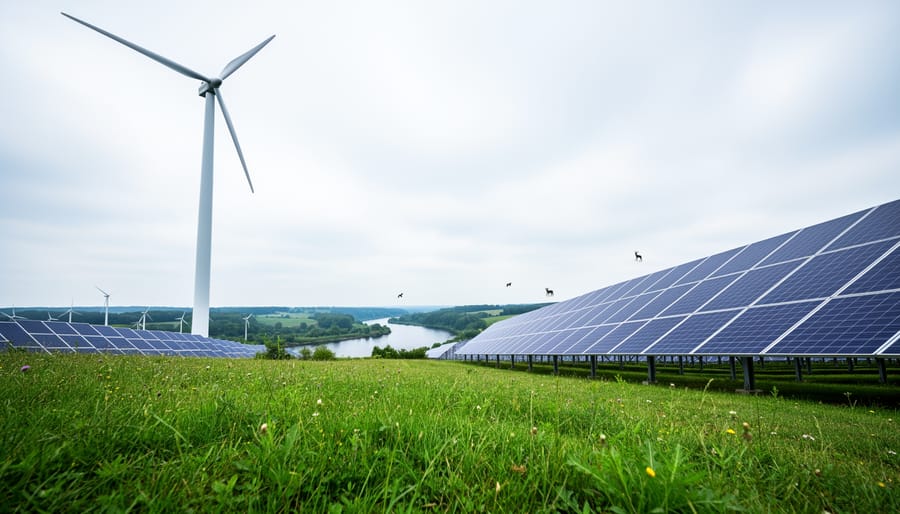
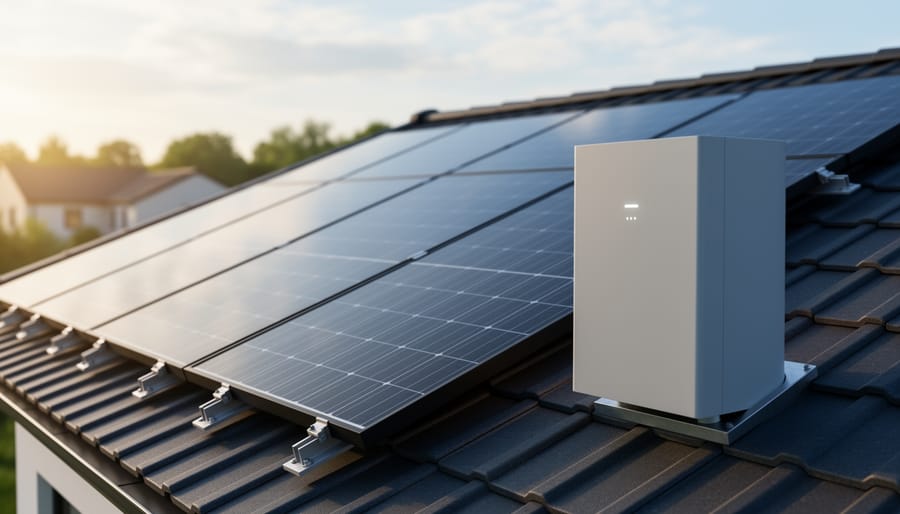
A solar panel system with battery storage combines rooftop or ground-mounted solar panels with rechargeable batteries that store excess electricity generated during the day for use at night, during outages, or when grid demand is highest. This setup transforms a standard solar installation from a daytime-only power source into a flexible, around-the-clock energy system that gives you control over when and how you use the clean electricity your panels produce.
The difference matters more than you might think. Without batteries, traditional grid-tied solar systems send surplus power back to the utility company during peak sun hours and draw from the grid after dark. You’re still tethered to utility rates and vulnerable to blackouts. Battery storage breaks that dependency, letting you bank your solar production for later use, shield yourself from rising electricity costs, and keep essential appliances running when the grid goes down.
Over the past few years, battery technology has improved dramatically while costs have dropped, making storage accessible for typical homeowners rather than just early adopters with deep pockets. Lithium-ion batteries now dominate the residential market, offering better performance and longer lifespans than older lead-acid models, and installers have streamlined the process to the point where adding storage to a new or existing solar array has become straightforward.
This guide walks you through exactly how solar battery systems work, the main components you’ll encounter, the different storage configurations available, and the practical factors that determine whether battery storage makes sense for your home and budget in 2026.
What Solar Battery Storage Means for Your Home
When you install solar panels on your home, they generate electricity during daylight hours, often more than you’re using at that moment. Without battery storage, that excess energy flows back to the electrical grid, and you receive credits through net metering programs. With battery storage, you capture that surplus power in on-site batteries, keeping it available for your own use when the sun goes down or during a power outage.
This fundamental shift changes how you interact with both your solar system and the utility grid. Instead of exporting your cleanest, most valuable energy to the grid during peak sunlight hours and then buying it back at night, you’re essentially creating a personal energy reservoir. Your solar panels charge the batteries during the day, and those batteries power your home in the evening, reducing or eliminating the need to pull electricity from the grid.
To understand what battery storage adds to your setup, it helps to know a few key concepts:
- Grid-tied system
- A solar installation connected to the utility grid that can both draw power from and send excess electricity back to the utility. Most residential solar systems operate this way.
- Battery storage
- Physical units that capture and hold excess solar electricity for later use, typically using lithium-ion technology similar to electric vehicle batteries.
- Net metering
- A billing arrangement where the utility credits you for surplus solar energy you export to the grid, offsetting the cost of power you draw when your panels aren’t producing.
- Backup power
- The ability of a battery system to keep essential appliances running during a grid outage, unlike standard grid-tied solar which shuts down for safety when the grid goes down.
- Energy independence
- Reducing reliance on the utility grid by storing and using your own solar generation, moving closer to self-sufficiency without necessarily going completely off-grid.
The practical difference shows up most clearly in three situations. First, you have power during blackouts, standard solar systems shut off when the grid fails, but batteries keep your lights on. Second, you use more of the electricity you actually generate rather than selling it cheap and buying it back expensive. Third, in areas with time-of-use rates where electricity costs more during evening peak hours, you’re using your stored daytime solar instead of paying premium grid prices.
Battery storage doesn’t eliminate your grid connection. Most homeowners stay connected for reliability and to have a backup when batteries run low during extended cloudy periods. What changes is how often and when you rely on the grid.
How Solar Panel Systems with Battery Storage Work
The Solar Generation Process
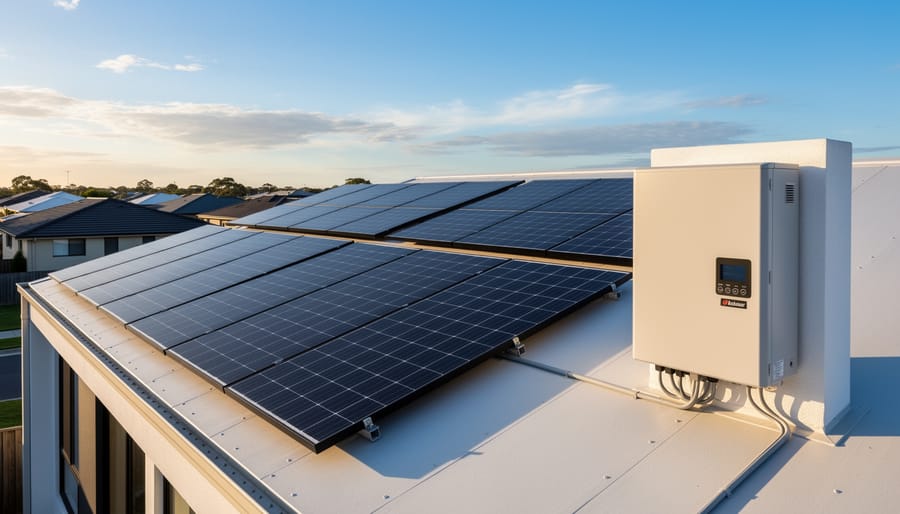
Solar panels work through the photovoltaic effect, when sunlight hits the silicon cells in each panel, it knocks electrons loose, creating a flow of direct current (DC) electricity. This process happens silently and continuously whenever there’s sufficient daylight, not just in bright sunshine. Even on overcast days, your panels generate power, though at reduced output compared to clear conditions.
The amount of electricity produced depends on panel efficiency, sunlight intensity, and installation factors like roof angle and shading. Modern residential panels typically convert 18-22% of incoming sunlight into usable electricity. Unlike thermal vs solar photovoltaic systems, which capture heat energy, photovoltaic panels generate electricity directly from light particles.
During peak sun hours, roughly 10 AM to 4 PM in most locations, your system produces its maximum output. A typical 6-kilowatt residential array might generate 25-35 kilowatt-hours on a sunny day, though this varies by season and geography. This DC electricity then flows to your inverter and battery system for conversion and storage, which we’ll cover in the next sections.
Storing Excess Energy
When your solar panels generate more electricity than your home is currently using, which happens often on sunny days, the system automatically directs that surplus power to charge your battery storage instead of sending it back to the grid. Think of it like filling a tank: the excess energy flows into the battery until it reaches full capacity.
Once your batteries are fully charged and your panels are still producing more than you need, the system has a decision to make. In grid-tied setups (the most common residential configuration), this extra power flows back to the utility grid, often earning you credits through net metering programs. If you have an off-grid system, the charge controller prevents overcharging by either diverting excess power to secondary loads or simply limiting panel output.
This automatic routing happens seamlessly through your inverter and energy management system, you don’t need to flip switches or monitor it constantly. The system prioritizes powering your home first, charging batteries second, and exporting to the grid (or curtailing production) only when both those needs are met. During winter months or extended cloudy periods, you might not see full batteries as often, since production barely meets household demand.
Using Stored Power
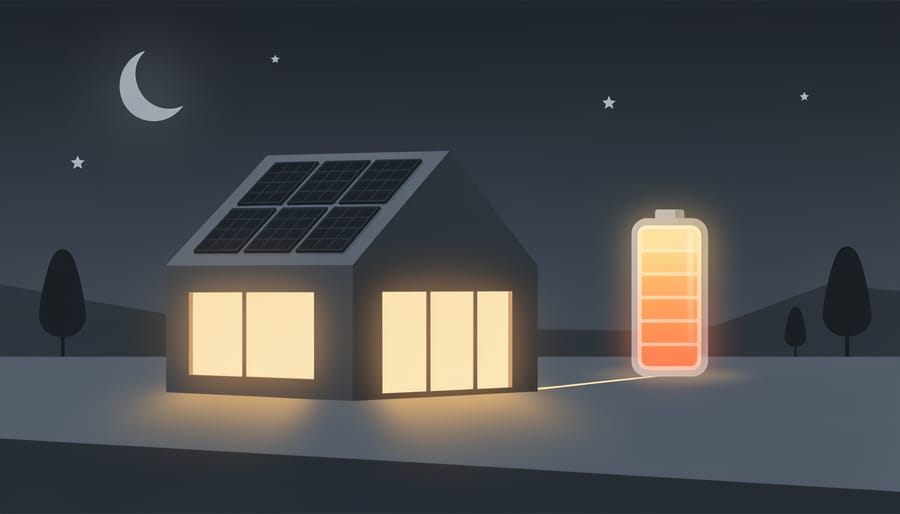
Once the sun sets or clouds roll in and your panels stop producing, your home automatically switches to battery power. The inverter detects the drop in solar generation and seamlessly draws electricity from the stored charge, no flipping switches or manual intervention required.
During a grid outage, the system disconnects from the utility line (a safety feature called islanding) and your battery takes over as the primary power source. How long it lasts depends on your battery’s capacity and which appliances you’re running. A typical 10-kWh battery might power essential loads like refrigeration, lights, and internet for several hours, or just critical circuits for a day or more. When solar production resumes the next morning, the panels recharge the battery while simultaneously powering your home.
Main Components of a Battery Storage System
Solar Panels
Solar panels are the starting point of any solar-plus-storage system. These flat, weather-resistant modules contain photovoltaic cells that convert sunlight directly into direct current (DC) electricity. When sunlight hits the cells, electrons begin moving, generating electrical power that flows through wiring to the rest of your system.
Most residential solar installations range from 5 to 10 kilowatts (kW) in total capacity, typically requiring 15 to 30 individual panels depending on panel wattage and your roof space. A standard home panel today produces between 300 and 400 watts under optimal conditions. The total system size you need depends on your household electricity consumption, roof orientation, and how much of your energy use you want to offset with solar generation.
Battery Units
Lithium-ion batteries dominate the residential solar storage market in 2026, accounting for over 90% of new installations. These batteries offer high energy density, long cycle life (typically 10-15 years or 4,000-6,000 charge cycles), and minimal maintenance. Within the lithium-ion category, lithium iron phosphate (LFP) chemistry has gained ground for its superior safety profile and longer lifespan, while nickel manganese cobalt (NMC) batteries provide slightly higher energy density in a smaller footprint.
Residential battery units typically range from 5 kWh to 20 kWh in capacity. A 10 kWh battery can power essential loads like refrigeration, lighting, and Wi-Fi for 8-12 hours, while larger households or those seeking whole-home backup often install multiple units or choose 15-20 kWh systems. Most batteries are modular, letting you start smaller and add capacity later.
Physical installation requires a climate-controlled space, usually a garage wall or exterior pad with weather protection. Each battery unit weighs 200-300 pounds and measures roughly 45 inches tall. Wall-mounted models save floor space but need sturdy backing. Proper ventilation and temperature regulation extend battery life, so installers avoid attics or uninsulated sheds.
Inverters and Charge Controllers
In a solar-plus-storage setup, the hybrid inverter acts as the system’s brain. It converts the DC electricity your panels produce into AC power your home can use, while simultaneously managing the flow of energy to and from your battery. When your panels generate more power than you’re using, the hybrid inverter directs the surplus to charge your battery. When the sun sets or demand spikes, it pulls stored DC power from the battery, converts it to AC, and sends it to your appliances.
Modern hybrid inverters also include charge controllers that prevent overcharging and deep discharge, protecting battery health and extending lifespan. Some models communicate with your utility meter to optimize when energy is stored versus exported based on time-of-use rates, making the entire system responsive to both your household needs and grid conditions.
Energy Management Systems
Once your solar panels and battery are installed, you’ll want them working together intelligently, that’s where an energy management system (EMS) comes in. This smart software acts as the brain of your setup, continuously monitoring your energy production, battery charge level, household consumption, and even your utility’s rate schedule.
The EMS automatically decides the best use for every kilowatt-hour you generate. If your utility charges more during evening hours, the system can store daytime solar energy and release it when rates peak, cutting your bill without any manual input. During grid outages, it instantly switches to battery power for your backed-up circuits. Some systems learn your household patterns over time, anticipating when you’ll need more power and adjusting storage accordingly.
Most modern EMS platforms include smartphone apps that let you track energy flow in real time, adjust priorities (like keeping the battery full for storm season), and review savings. The technology keeps improving, with newer models integrating weather forecasts and even vehicle charging schedules to maximize your solar investment.
Types of Solar Battery Storage Setups
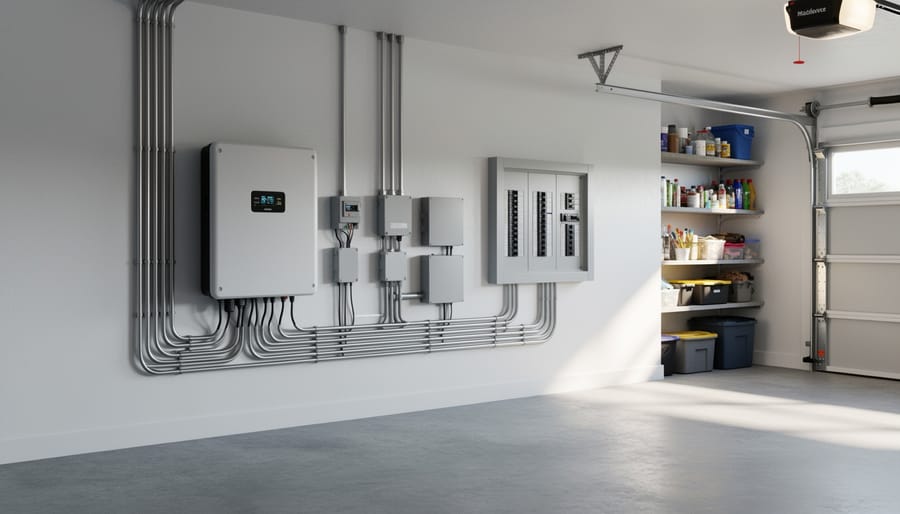
When you’re shopping for a solar battery system, you’ll encounter several configuration options, each with its own trade-offs in terms of installation complexity, flexibility, and cost. Understanding these setups helps you match the technology to your specific needs and existing infrastructure.
AC-Coupled vs. DC-Coupled Systems
The coupling method determines where your battery connects in the energy flow. DC-coupled systems integrate the battery before the inverter, so solar power flows directly into storage as direct current. This approach is more efficient because electricity doesn’t get converted multiple times, and it’s the simpler choice for new installations where everything gets designed together from the start.
AC-coupled systems connect the battery after the inverter, storing alternating current. This setup works well if you’re adding storage to an existing solar installation, since you can keep your current inverter and just add a separate battery inverter. The trade-off? You lose a bit of efficiency through the extra conversion step, but you gain flexibility and easier retrofitting.
Whole-Home vs. Critical-Load Backup
How much of your house do you want to power during an outage? Whole-home backup systems can run everything, your air conditioning, electric range, and every outlet. This requires a larger battery bank and costs more upfront, but you won’t need to change your lifestyle during a blackout.
Critical-load backup takes a more targeted approach. Your installer wires specific circuits (refrigerator, a few lights, phone chargers, maybe your internet router) to a dedicated backup panel. When the grid goes down, only these essentials draw from your battery. You’ll use less stored energy, your battery lasts longer during the outage, and you can get by with a smaller, less expensive system.
Grid-Tied with Storage vs. Off-Grid
Most residential battery systems remain connected to the utility grid. You pull from the grid when your solar and battery can’t cover demand, and you can export excess power for credits. This grid-tied approach offers the best of both worlds: backup power when you need it and the grid as a safety net.
Off-grid systems cut the utility connection entirely. You’re fully self-sufficient, but you need enough solar panels and battery capacity to cover your worst-case scenario, multiple cloudy days in winter, for instance. Off-grid makes sense for remote properties where grid connection costs are prohibitive, but it requires careful sizing, lifestyle adjustments, and often a backup generator for extended low-sun periods.
When and How Solar Battery Storage Is Used
Backup Power During Outages
When the power grid goes down, a solar battery storage system automatically detects the outage and switches to backup mode within milliseconds. Your stored solar energy powers whichever circuits you’ve designated as essential, typically refrigerators, lights, medical equipment, internet routers, and heating or cooling systems. The battery keeps these running for hours or even days, depending on your storage capacity and how much power you’re using.
Without battery storage, even a solar panel system shuts off during outages for safety reasons, grid-tied inverters stop producing power to protect utility workers repairing the lines. Batteries change that equation entirely, giving you genuine energy security when you need it most. The key is sizing your system to match your actual backup priorities rather than trying to run every appliance at once.
Maximizing Solar Self-Consumption
During daylight hours, your solar panels often generate more electricity than your home needs. Without battery storage, that surplus flows back to the grid, sometimes earning you credits, but usually at rates far lower than what you pay when buying power back at night. Battery storage flips this equation by capturing your excess daytime solar energy and holding it until evening when you actually need it.
This approach cuts your utility bills more effectively than net metering alone. Instead of selling power cheap and buying it back expensive, you’re using your own stored energy to run lights, appliances, and climate control after sunset. The result is fewer kilowatt-hours purchased from the grid each month and greater return on your solar investment.
Managing Time-of-Use Electricity Rates
Time-of-use (TOU) electricity rates charge different prices depending on when you use power, typically higher during afternoon and evening peak hours when demand is greatest, and lower overnight or midday when fewer people are drawing from the grid. If your utility offers TOU pricing, battery storage can deliver substantial energy bill savings by letting you avoid expensive peak rates entirely. Your system charges the batteries with solar power during the day (when rates may already be low) or draws cheap grid electricity overnight if needed, then discharges that stored energy during peak evening hours when you’d otherwise pay premium rates. Smart energy management software automates this cycle, learning your household’s usage patterns and rate schedule to maximize savings without any manual effort on your part.
Reducing Grid Dependence
Adding battery storage to your solar panels lets you cover more of your daily energy needs from your own system. Instead of drawing heavily from the utility at night, you use power you generated earlier, shrinking your grid reliance without the complexity or expense of cutting ties entirely. Many homeowners find this middle ground delivers most of the independence they want while keeping the grid as a backup when needed.
Sizing Your Battery Storage System

Figuring out the right battery size isn’t about guessing, it’s about matching your storage to how you actually use electricity and what you want the battery to do.
Start with your daily energy consumption. Look at a few recent utility bills and find your average kilowatt-hours used per day. Most U.S. homes use between 25 and 35 kWh daily, though this varies with climate, home size, and lifestyle. A kilowatt-hour is simply the amount of energy needed to run a 1,000-watt appliance for one hour, your refrigerator might use 1-2 kWh per day, while running central air conditioning can consume 15-20 kWh on a hot afternoon.
If you want backup power during outages, decide which essentials you need to keep running. A whole-home backup requires significantly more capacity than just covering your refrigerator, a few lights, internet router, and phone chargers. Prioritizing critical loads lets you work with a smaller, more affordable battery. For example, backing up essential circuits for 24 hours might need 10-15 kWh of storage, while whole-home backup for the same period could require 30 kWh or more.
Most residential batteries fall between 10 and 15 kWh per unit. Popular models like the Tesla Powerwall offer 13.5 kWh, the LG Chem RESU provides 9.8-16 kWh depending on the version, and Enphase IQ batteries start at 3.36 kWh but stack modularly. You can install multiple batteries if your needs exceed what one unit provides, though that increases upfront costs.
Your solar system’s size matters too. If your panels generate more excess energy than your battery can store, that surplus still goes to the grid. Conversely, oversized batteries that rarely fill won’t deliver good value. A well-matched system typically has storage capacity equal to 30-50% of your daily energy use if you’re focused on self-consumption, or closer to 100% if backup resilience is the priority.
Cost Considerations and Incentives for 2026
Adding battery storage to a solar panel system represents a significant investment, but the financial landscape in 2026 includes multiple pathways to make it more affordable. Understanding both the upfront costs and the available incentives helps you build a realistic budget and timeline for return on investment.
A complete residential solar-plus-storage system typically ranges from $25,000 to $45,000 installed, depending on system size and battery capacity. That breaks down to roughly $15,000 to $25,000 for the solar array itself, with batteries adding another $10,000 to $20,000. A single lithium-ion battery with 10-13 kWh of usable capacity, enough to cover essential loads during an outage, generally costs $8,000 to $12,000 before incentives. Larger homes or those seeking whole-home backup often install two or more battery units, which pushes costs higher but delivers proportionally more storage.
The federal Investment Tax Credit (ITC) remains one of the strongest incentives for 2026, covering 30% of the total system cost when batteries are charged exclusively by solar panels. That means a $35,000 system effectively costs $24,500 after the credit. State and local incentives vary widely but can add thousands more in savings. Some utilities offer rebates for battery installations that provide grid services, while certain states have separate storage incentive programs or property tax exemptions for solar equipment.
When evaluating the financial picture, consider these factors:
- Total upfront cost including equipment, installation, permits, and inspections
- Federal tax credit value and your ability to claim it in the current tax year
- State rebates, utility incentives, or solar renewable energy certificates (SRECs) available in your area
- Financing options such as solar loans, home equity lines, or power purchase agreements
- Your utility’s rate structure, including time-of-use pricing and net metering policies
- Estimated payback period based on monthly savings and avoided utility costs
- Warranty coverage for panels (typically 25 years) and batteries (usually 10 years)
Payback timelines for solar-plus-storage systems generally fall between 8 and 15 years, though this varies considerably based on local electricity rates, usage patterns, and available incentives. Homes in areas with high electricity costs, frequent outages, or unfavorable net metering policies see faster returns. The system continues delivering value well beyond payback, solar panels often produce efficiently for 30+ years with minimal upkeep beyond basic maintenance tips.
Many installers now offer financing that requires little or no money down, with monthly payments structured to match or fall below your current utility bill. This approach lets you start saving immediately while spreading the investment over time, though you’ll want to compare interest rates and total loan costs carefully against paying upfront if you have the capital available.
Installation and Maintenance Requirements
Installing a solar panel system with battery storage typically takes one to three days for the physical work, though the full timeline from contract signing to activation often spans several weeks due to permitting and utility coordination. Your installer handles most of the administrative work, including submitting permit applications to local building departments and scheduling required inspections after installation.
During the installation itself, expect crews to mount panels on your roof or ground area, install the battery unit (usually in a garage, basement, or exterior wall location), and connect everything through your home’s electrical system. The process involves some noise and activity around your property, but reputable installers protect your landscaping and clean up thoroughly when finished. Most jurisdictions require an electrical inspection before the utility grants permission to operate, which can add a few days to a week to your timeline.
Once your system is running, maintenance requirements are refreshingly minimal. Solar panels need no regular servicing beyond occasional cleaning if you live in a dusty area or notice heavy pollen buildup, rain handles most cleaning naturally. Battery units are sealed systems with no user-serviceable parts. Most manufacturers recommend a professional solar service check every few years to verify connections and software updates, though many systems send performance alerts directly to your installer.
Your battery’s management system monitors itself continuously, and you’ll receive notifications through a smartphone app if anything needs attention. Knowing when to call an installer such as unexplained drops in battery capacity or error messages, helps you address small issues before they become larger problems, though these situations are uncommon with quality equipment properly installed.
Frequently Asked Questions
How long do solar batteries actually last? Most lithium-ion solar batteries are warrantied for 10 years and designed to retain at least 70% of their original capacity by the end of that period. In practice, many units continue functioning beyond the warranty window, though their storage capacity gradually diminishes. The rate of degradation depends on how heavily you cycle the battery, the operating temperature, and whether you regularly drain it to near-empty. Keeping your battery in a climate-controlled space and avoiding extreme charge/discharge cycles can extend its useful life.
Are solar batteries safe, and what about fire risk?
Modern lithium-ion solar batteries include multiple safety systems, thermal management, overcharge protection, and fire-resistant enclosures, making them very safe for residential use. Fire incidents are extremely rare and typically involve manufacturing defects or improper installation rather than normal operation.
Can I add battery storage to my existing solar panel system?
Yes, batteries can be retrofitted to most existing grid-tied solar systems using an AC-coupled configuration. You’ll need to ensure your current inverter is compatible or add a separate battery inverter, and your installer will verify that your electrical panel can handle the additional equipment.
Do solar batteries work in extreme heat or cold?
Lithium-ion batteries perform best between 50°F and 85°F, but quality units include thermal management systems that maintain safe operating temperatures in most climates. Extreme cold can temporarily reduce charging efficiency, while extreme heat may trigger protective shutdowns if the battery gets too warm.
Will my battery make noise?
Solar batteries themselves are silent. You might hear a faint hum from the inverter or cooling fans during active charging or discharging, but the sound is typically quieter than a refrigerator and won’t be noticeable in living spaces.
What happens during a long stretch of cloudy weather? Your battery will charge more slowly when solar production drops, but it won’t stop working. If several overcast days drain your stored energy, the system automatically draws from the grid to keep your home powered. You’re not stranded without electricity, you simply use less solar and more grid power until the sun returns. This is why most homeowners with batteries stay grid-connected rather than going fully off-grid.
The bottom line: solar battery storage is a mature, safe technology with predictable performance characteristics. Understanding these practical realities helps you set realistic expectations and make informed decisions about whether adding storage to your solar system makes sense for your household.
Solar panel systems with battery storage represent a practical step toward energy independence and resilience for homeowners in 2026. By capturing and storing the sun’s energy for use whenever you need it, whether during evening hours, peak-rate periods, or unexpected outages, these systems transform how you power your home and interact with the grid.
The technology isn’t right for everyone. Your location, energy consumption patterns, utility rate structure, and budget all factor into whether the investment makes sense. But for those facing frequent power interruptions, high time-of-use rates, or simply wanting greater control over their energy future, the value extends well beyond monthly bill savings. You gain backup security, reduce fossil fuel dependence, and contribute to a cleaner grid.
Start by reviewing your household’s energy usage and identifying your priorities. Is backup power your main concern, or are you more focused on maximizing solar self-consumption? Research the incentives available in your state, many programs significantly reduce upfront costs. Then connect with qualified solar installers who can assess your property, explain configuration options, and design a system sized to your actual needs rather than an oversized setup you don’t require.
The goal isn’t perfection or going completely off-grid overnight. It’s making a meaningful improvement in how you generate, store, and use energy at home. Done thoughtfully, solar battery storage delivers both practical benefits today and long-term environmental impact you can feel good about.